

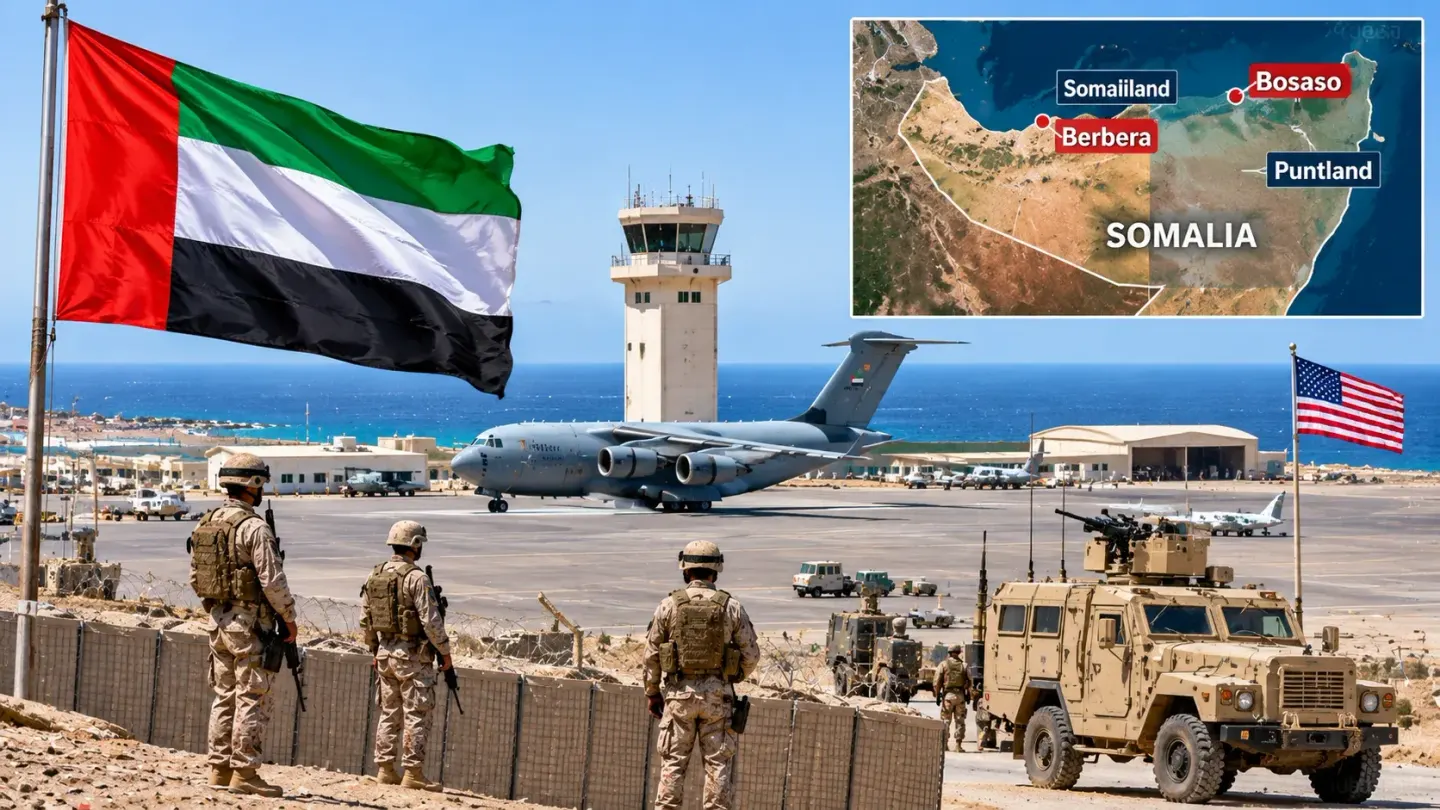
The United Arab Emirates (UAE) has quietly transformed civilian airports in Somalia's breakaway regions of Somaliland and Puntland into strategically important military facilities, raising questions about its growing influence across the Horn of Africa and the potential involvement of the United States.
An investigation based on satellite imagery and flight-tracking data has revealed how two airports, located in Berbera and Bosaso, have evolved from relatively basic airstrips into heavily secured facilities featuring military infrastructure, aircraft shelters, underground structures, air defense positions, and helicopter landing areas.
The developments highlight the UAE's expanding military and logistical presence in a strategically important region connecting Africa and the Middle East. They also suggest that the United States could increasingly rely on these facilities as alternative operational locations amid growing security concerns linked to the conflict with Iran.
The first major facility examined in the investigation is Berbera Airport in Somaliland, a self-declared independent region that remains internationally recognized as part of Somalia.
Berbera has a long history of foreign military interest. The Soviet Union originally constructed the airstrip during the 1970s as a strategic military foothold in the region. During the 1980s, the United States also considered it a contingency landing location for the Space Shuttle program.
The UAE became involved in the airport's development in 2018, when construction crews began resurfacing the runway and developing basic aviation infrastructure, including aircraft parking facilities.
However, satellite images from subsequent years indicate that the site gradually underwent a significant transformation.
By 2024, new fortified structures had appeared across the facility, including buildings that could be used for secure military equipment storage. Additional underground storage infrastructure was also under construction.
Further developments became visible in 2026. Satellite imagery revealed defensive positions along the airport's perimeter, creating a heavily secured security zone covering an area approaching the size of Manhattan.
The investigation also identified what appeared to be designated air defense positions and newly constructed helicopter landing pads.
These developments suggest that Berbera has evolved beyond an ordinary civilian airport into a military logistics and operational hub used by the UAE.
Aircraft movements and satellite imagery provide further indications of the facility's military role. Cargo planes associated with UAE military operations have reportedly landed at Berbera, while pickup trucks and other vehicles have been observed stored beneath aircraft shelters.
Other images appear to show military transport trucks carrying pickup vehicles, potentially destined for conflict zones in Sudan or Ethiopia.
The findings are consistent with previous investigations documenting allegations that the UAE has used aviation infrastructure to facilitate the movement of weapons, equipment, and personnel connected to conflicts in the region.
The investigation also examined why Berbera could become increasingly important to Washington as tensions involving Iran continue to affect regional security.
In September 2026, Yemen's Iran-backed Houthi movement reportedly expanded its control along parts of the Yemeni coastline, raising concerns about the security situation around important maritime routes and increasing the strategic significance of the Horn of Africa.
Flight-tracking data revealed that US military aircraft had traveled to Berbera twice during the previous year. One particularly notable flight in August reportedly transported special operations commanders from Djibouti, where the United States maintains its only permanent military base in Africa.
The aircraft subsequently continued east toward Bosaso in Puntland, prompting further investigation into the second airport.
Bosaso appears to have undergone a transformation similar to Berbera's. Satellite imagery reportedly shows aircraft hangars equipped with helicopter landing areas, underground construction projects, and active air defense infrastructure.
The investigation also identified drones believed to be associated with UAE operations against the al-Shabab militant group in Somalia.
Together, the developments suggest that the UAE has established two strategically positioned military facilities along the Somali coastline, strengthening its ability to operate across the Horn of Africa and nearby conflict zones.
UAE officials reportedly did not respond to questions about the military infrastructure identified at Berbera and Bosaso.
The United States also appears to be developing a limited operational relationship with the region.
According to two people familiar with US operations in Bosaso, American special operations forces already have approximately two dozen personnel stationed there. Their mission is reportedly to support Puntland's efforts to combat terrorism.
However, the sources indicated that Washington is not planning to establish a permanent military presence in Bosaso.
US officials also said they do not intend to establish a permanent base at Berbera. Instead, they are considering cooperation with regional partners to protect American interests and provide specialized military capabilities.
These developments come at a time when the conflict with Iran has increased concerns about the vulnerability of American military installations across the Middle East.
The emergence of military facilities in Berbera and Bosaso could therefore offer Washington additional operational flexibility without requiring a large permanent deployment.
The broader strategic picture now includes three important military locations in the Horn of Africa: the established US base in Djibouti and the developing facilities in Berbera and Bosaso.
While the UAE appears to be using its infrastructure to expand its regional influence and logistical capabilities, the United States could increasingly benefit from access to these locations through cooperation with local partners.
The transformation of civilian airports into military infrastructure illustrates how the Horn of Africa is becoming an increasingly important arena for international competition.
With conflicts continuing in Sudan, Ethiopia, Yemen, and the wider Middle East, the strategic value of Berbera and Bosaso is likely to attract growing attention from regional and international powers.
For now, the United States appears interested in maintaining a limited presence rather than establishing permanent bases. Nevertheless, the expanding military infrastructure developed by the UAE could give Washington new options as it reassesses its security strategy across the Red Sea, the Gulf of Aden, and the Horn of Africa.




Comments
A free account lets you join the discussion.
Loading comments…