

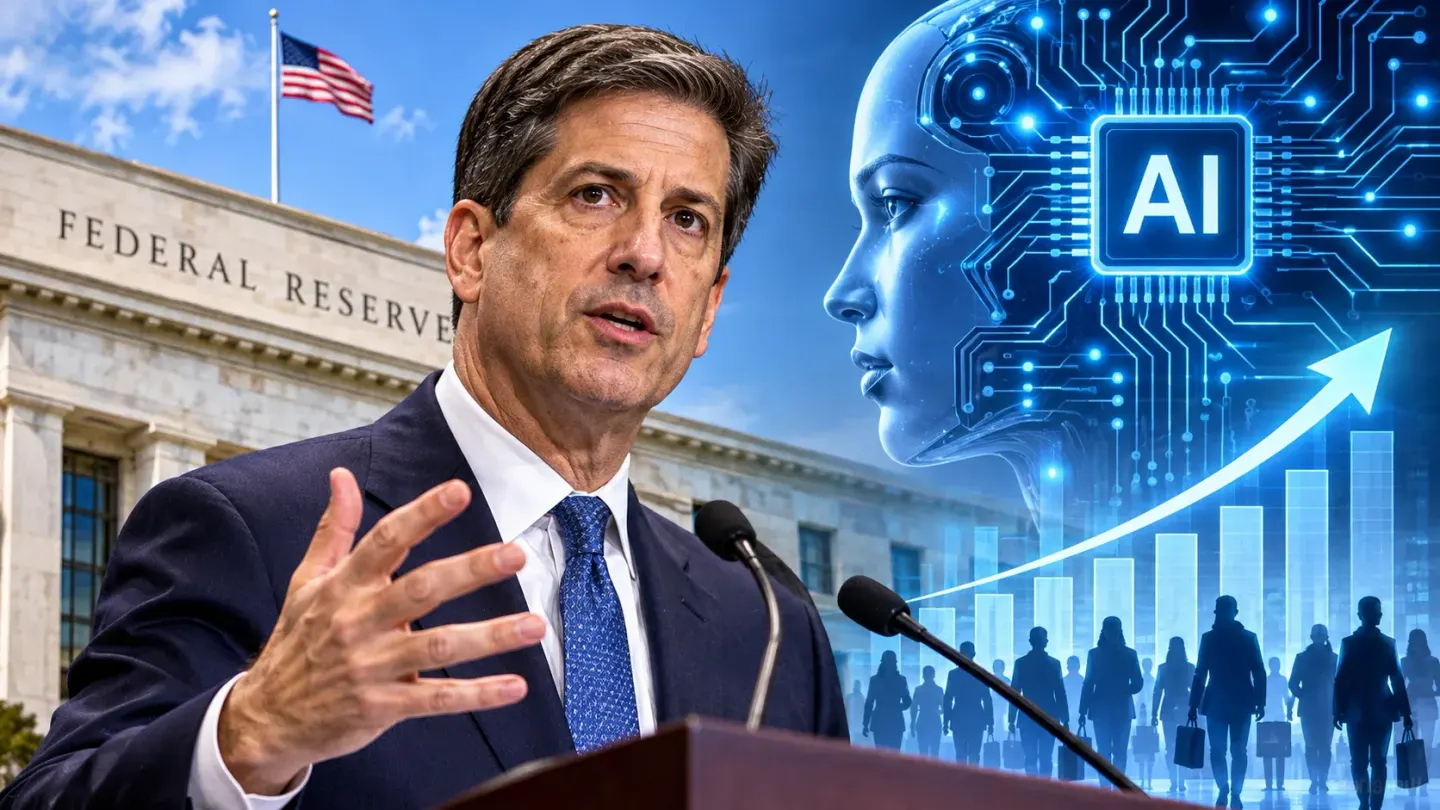
The Federal Reserve is taking a closer look at how artificial intelligence (AI) could reshape the US economy, transform the labor market, influence productivity, and affect inflation. As AI adoption accelerates across industries, policymakers are increasingly concerned about who will benefit financially from the technology and whether its economic impact could create new challenges for workers and businesses.
At an unusual Federal Reserve event in San Francisco, Fed Chairman Kevin Warsh brought together technology leaders, economists, and industry experts to discuss the potential consequences of the AI revolution. Rather than providing definitive predictions, the discussion focused on major questions surrounding employment, economic growth, investment, and monetary policy.
One of the central issues raised by Warsh was who would ultimately benefit from the financial gains generated by artificial intelligence. He questioned whether AI-driven productivity improvements would translate into higher wages for workers, lower prices for consumers, or greater profits for companies and owners of capital.
The discussion is part of a task force established by Warsh to help the Federal Reserve understand how AI could affect jobs, productivity, and future interest rate decisions. The findings could influence how the central bank responds to economic changes over the coming months and years.
Among the prominent participants was venture capitalist Marc Andreessen, who offered an interesting perspective on AI's potential impact on employment. Andreessen argued that artificial intelligence might not eliminate as many jobs as some experts fear, partly because heavily regulated industries limit how quickly new technologies can be adopted.
He pointed to healthcare, education, housing, and legal and government administration as sectors where regulatory restrictions could slow the pace of technological transformation.
While this argument may offer some reassurance to workers concerned about widespread job losses, it also raises questions about future economic growth. If AI cannot spread quickly across major industries, its potential to significantly increase productivity and accelerate economic expansion could remain limited.
Another important perspective came from economist Chad Jones, a Stanford professor currently on leave at AI company Anthropic. Although Jones did not speak to the press during the event, his research explores how artificial intelligence interacts with existing jobs and workplace responsibilities.
One example involves the use of AI in medical imaging. Artificial intelligence systems can help identify potential abnormalities in X-rays and assist radiologists in detecting medical conditions. However, these systems can also generate false positives, requiring human professionals to review and correct their findings.
Jones describes these limitations as weak links. Such weaknesses could determine whether AI becomes a genuinely transformative economic force or simply another technology that produces incremental improvements.
The speed at which businesses adopt artificial intelligence is another major concern for economists and Federal Reserve policymakers.
J.P. Morgan economist Stephanie Aliaga discussed the difference between technological progress and its actual adoption across the economy. Although AI capabilities are advancing rapidly, its widespread integration into businesses is happening at a considerably slower pace.
Aliaga noted that approximately 72% of current work tasks appear exposed to automation or assistance from emerging technologies, including large language models, software, and robotics.
However, exposure does not necessarily mean that entire jobs will disappear. Instead, AI could gradually change the responsibilities employees perform, creating a significant restructuring of the modern workforce.
For the Federal Reserve, understanding these changes will be essential when assessing employment trends, productivity, and the broader economic consequences of automation.
One particularly concerning issue involves knowledge workers and employees performing administrative tasks. Economists are examining whether AI could create a major labor market disruption similar to the economic shock caused by increased competition from China.
Workers involved in routine administrative responsibilities could face greater displacement risks. The discussion highlighted that middle-aged women working in administrative positions may be particularly vulnerable, partly because transitioning into new occupations could prove more difficult for them.
The future of AI infrastructure is also becoming a political and economic issue in the United States.
Former Rhode Island Governor Gina Raimondo expressed concern about growing public opposition to data center construction. She argued that stopping data center development could negatively affect America's technological competitiveness and limit potential economic benefits.
According to the discussion, 53 local ballot proposals concerning data centers appeared during the midterm elections, with voters supporting restrictions on development in 52 cases.
Raimondo emphasized that data centers can generate employment opportunities, tax revenue, and investment for local communities. However, she acknowledged the importance of negotiating better agreements with residents and addressing concerns before opposition becomes even stronger.
The growing resistance highlights the need for a better relationship between technology companies and local communities as AI infrastructure expands across the country.
Meanwhile, the rapid expansion of AI investment is creating another challenge for the Federal Reserve: inflation.
Technology companies are spending enormous amounts of money on AI infrastructure, increasing demand for computer chips, electronic components, and other essential equipment. This investment could contribute to higher prices across parts of the economy, potentially complicating the Fed's efforts to control inflation.
One participant emphasized that inflation has remained above the Federal Reserve's target for more than five years, arguing that stronger action may be necessary to bring price increases under control.
However, the broader economic picture is complicated. The US economy is currently described in the discussion as being at full employment, meaning the Federal Reserve may not need to rush toward lowering interest rates.
Instead, policymakers must determine whether AI investment will increase the economy's long-term growth potential enough to support higher interest rates without creating unnecessary economic pressure.
Another important issue involves how much AI-related investment is actually contributing to US economic growth.
According to figures discussed by J.P. Morgan's economist, AI-related investment has contributed approximately half of real economic growth over the past year when measured before subtracting imports. However, after accounting for imports, that contribution falls to less than one-fifth.
This difference raises questions about how AI investment is being measured and how much economic value is genuinely being generated within the United States.
Ultimately, the Federal Reserve's discussions demonstrate that artificial intelligence is becoming an increasingly important factor in economic policymaking. While the technology promises improvements in productivity, innovation, and business efficiency, its effects on employment, inflation, wages, and economic growth remain uncertain.
Warsh is seeking answers not only about the immediate consequences of AI but also about what could happen over the next six, 12, and 18 months.
The challenge for the Federal Reserve will be understanding these changes early enough to make informed decisions about monetary policy. As companies continue investing billions in artificial intelligence, policymakers must determine whether the technology will deliver lasting economic growth, create significant employment disruptions, or introduce new inflationary pressures.
For now, the AI revolution is creating more questions than answers, and the Federal Reserve is preparing to confront its economic consequences.




Comments
A free account lets you join the discussion.
Loading comments…