

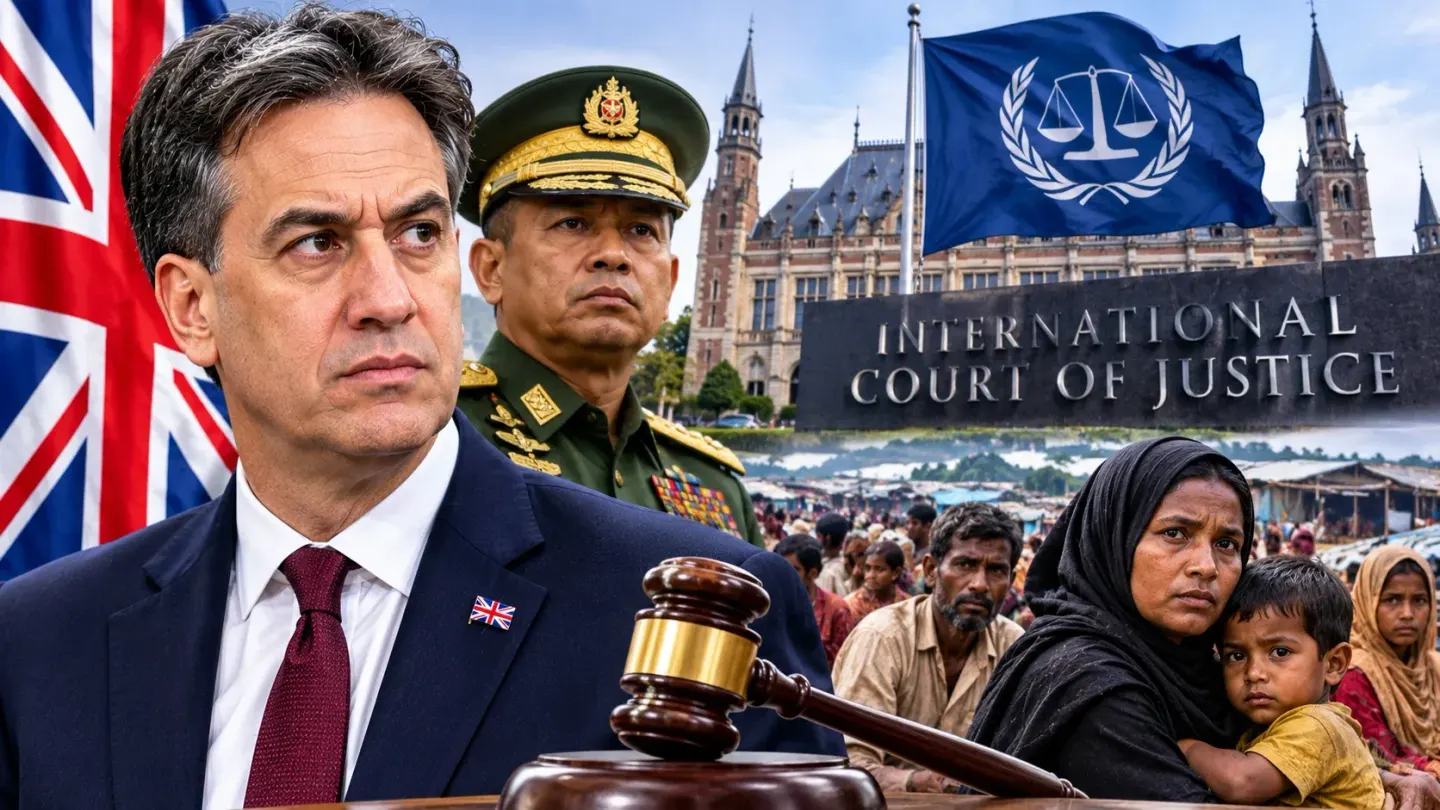
The United Kingdom has expelled Myanmar's defence attaché following a landmark ruling by the International Court of Justice (ICJ) concerning the alleged genocide of the Rohingya Muslim minority during Myanmar's 2017 military operations. The decision marks a significant diplomatic response to a historic legal judgment that has renewed international attention on the suffering of the Rohingya population.
The ICJ concluded that the evidence surrounding Myanmar's 2017 military clearance operations supported a reasonable inference that the country's security forces acted with genocidal intent. The court examined the circumstances surrounding the violence and found that the environment created by Myanmar's security forces contributed to widespread atrocities against the Rohingya community.
Following the ruling, UK Foreign Secretary Ed Miliband announced the expulsion of Myanmar's defence attaché from Britain. The UK government also summoned Myanmar's chargé d'affaires to address the developments and express its response to the court's findings.
The case concerns the military operations launched in Myanmar's Rakhine State in 2017, which forced more than 700,000 Rohingya people to flee across the border into neighbouring Bangladesh. Many survivors remain in refugee camps, particularly in Cox's Bazar, which hosts one of the world's largest refugee settlements.
The court's findings highlighted allegations of large-scale killings, sexual violence and the deliberate burning of Rohingya villages during the military operations. According to the proceedings, at least 10,000 Rohingya people were killed during the crackdown.
The Gambia initiated the legal proceedings against Myanmar at the International Court of Justice, seeking accountability for the treatment of the Rohingya minority. The case was brought under the Genocide Convention, to which both countries are parties.
The judgment has been met with considerable emotion and relief among Rohingya refugees living in Bangladesh. Many survivors watched the proceedings on television screens in refugee camps, viewing the ruling as an important step toward recognition and justice after years of displacement and suffering.
For many Rohingya families, however, the decision represents only the beginning of a longer struggle. Refugees have expressed hopes of returning to their homes in Myanmar with dignity, receiving citizenship and having their rights formally recognized. Many also want accountability for the loss of family members and the destruction of their communities.
The court's findings have also placed renewed attention on the responsibilities of Myanmar's authorities. Among the issues highlighted are dignified burials for victims, recognition of Rohingya citizenship rights and compensation for those affected by the violence. Myanmar is expected to provide information about its proposed compensation measures within two years.
The ruling could also have wider implications for international law and other genocide-related proceedings before the ICJ. Legal observers are likely to examine its findings in connection with other cases, including South Africa's genocide case against Israel.
The United Kingdom's decision to expel Myanmar's defence attaché further underscores the international diplomatic consequences of the ruling. For the Rohingya community, the judgment represents an important milestone in the pursuit of justice, recognition and the possibility of a safe and dignified return to their homeland.




Comments
A free account lets you join the discussion.
Loading comments…