

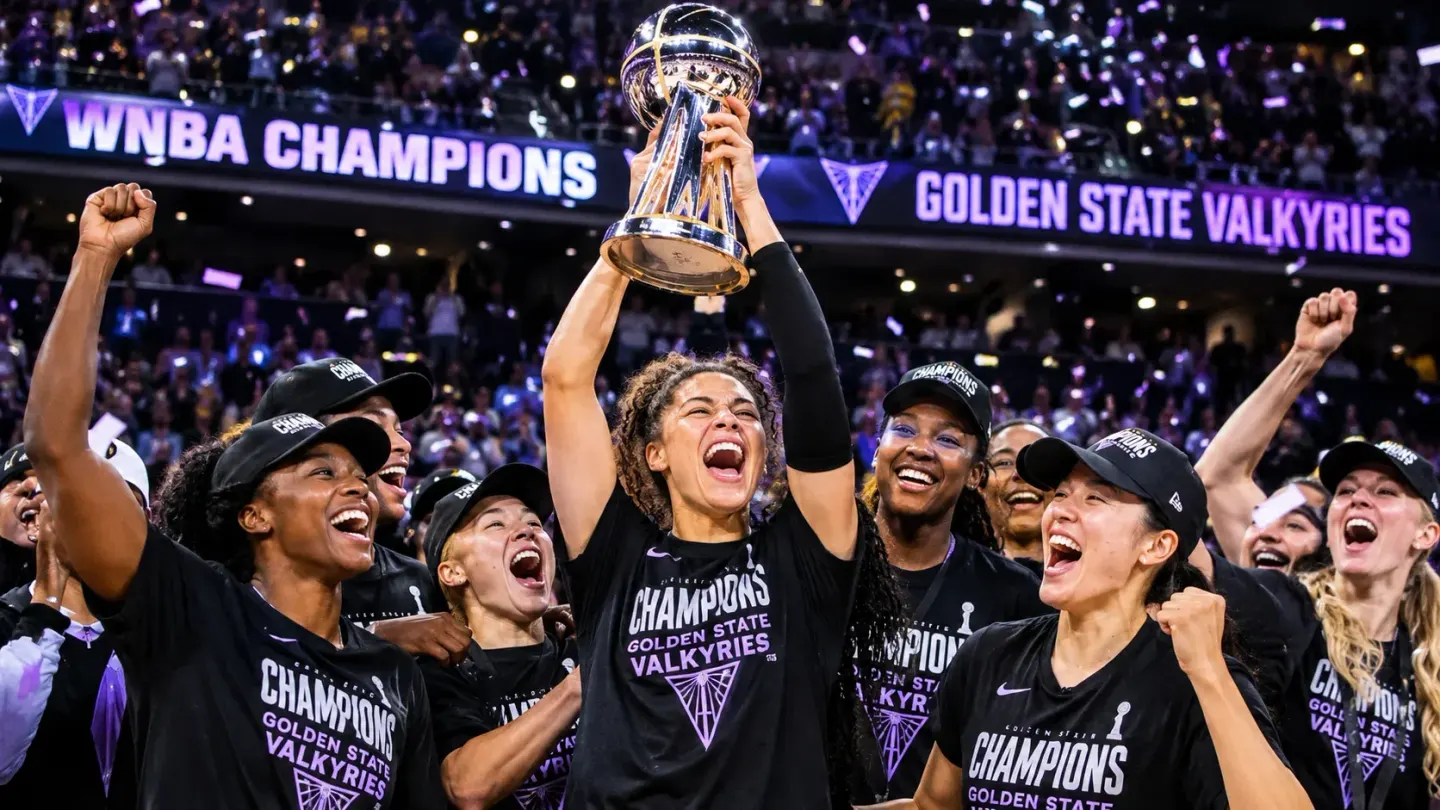
Golden State Valkyries Make WNBA History With Championship Comeback Against Atlanta Dream
The Golden State Valkyries have completed one of the most remarkable achievements in professional basketball, capturing the WNBA championship in their second season after defeating the Atlanta Dream 68–63 in a historic Game 7 of the Finals. The victory marked a defining moment for the expansion franchise, which turned early doubts about its roster into a championship-winning campaign built on defensive discipline, collective effort and a powerful team culture.
The decisive game delivered a dramatic conclusion to a closely contested series and made history as the first Game 7 in WNBA Finals history. With the championship on the line, Golden State demonstrated the qualities that had carried it through the season, overcoming a difficult first half and producing a second-half performance that Atlanta could not match.
At the center of the victory was Gabby Williams, who delivered a spectacular scoring performance when her team needed her most. After managing just two points in the first half, Williams exploded for 28 points after the break, setting a record for the most points scored in a single half in WNBA Finals history, according to the postgame analysis. She finished with 30 points and earned Finals MVP honors for her outstanding contribution to the championship victory.
Her performance was more than an individual scoring achievement. It reflected the confidence and responsibility that Golden State had placed in her when building its roster. Williams responded to the pressure of the championship game by attacking the basket, creating her own opportunities and converting shots from multiple areas of the floor.
The turning point came immediately after halftime. Golden State needed a spark after struggling offensively in the opening two quarters, and Williams supplied it with an aggressive approach that transformed the contest. She scored 15 points in the third quarter alone, helping the Valkyries regain control and shift the momentum in their favor.
Williams later credited head coach Natalie Nakase for encouraging her to remain patient during the first half. Rather than forcing difficult shots, she adjusted her approach and became more decisive when opportunities emerged. The result was a performance that will stand out as one of the defining moments in the franchise's early history.
The championship also represented a victory for a team that had been questioned for its lack of established superstar power. When Golden State assembled its roster, critics questioned whether an expansion franchise could quickly develop into a serious contender. The Valkyries answered those doubts by building a group of experienced competitors, international talent and hardworking players who embraced specific roles.
Williams captured that collective spirit in her postgame comments, emphasizing that the team's success came from having good people, dedicated workers and players willing to sacrifice personal statistics for the greater objective. She highlighted the group's commitment to defense, rebounding and doing whatever was necessary to win.
That philosophy became the foundation of Golden State's championship run. Instead of relying exclusively on individual scoring, the Valkyries established an identity around defensive pressure, communication and accountability. Their ability to make opponents uncomfortable proved especially important in the deciding game against Atlanta.
Golden State's defensive organization disrupted the Dream's offensive rhythm and frequently forced them into isolation-heavy possessions late in the shot clock. Atlanta struggled to maintain consistent ball movement during important stretches, allowing the Valkyries to dictate the pace and limit high-quality scoring opportunities.
Stokes' ability to provide help defense, contest shots and disrupt Atlanta's attempts to score near the basket became an important part of Golden State's strategy. She also delivered a crucial late putback that added to the Valkyries' momentum during the decisive contest.
Her contribution illustrated a broader truth about the championship: the players who make the biggest difference are not always those who score the most points. Defensive positioning, rebounding, physical effort and timely plays often determine the outcome of closely contested Finals games.
Veronica Burton also embodied the determination that defined the Valkyries' roster. Having faced uncertainty during her professional career, including being waived and working to improve her offensive game, Burton emerged as an important contributor to the championship team. Her development demonstrated how perseverance and continued improvement can create new opportunities in professional basketball.
As a floor general, Burton helped organize the offense while showing the confidence to score when required. Her early contributions helped Golden State remain competitive during the first half, when Williams had yet to find her scoring rhythm.
Head coach Natalie Nakase also received considerable credit for guiding the Valkyries through the series. Her defensive philosophy remained central to the team's success, but her willingness to make adjustments proved equally important.
A significant change came during Game 4, when Nakase altered the starting lineup and tightened the rotation. The adjustments included bringing Tiffany Hayes and Kyla Charles into the starting group, helping Golden State regain its footing in the series.
The changes reflected a coach who was willing to respond to what was happening on the court rather than remain committed to a single plan. Nakase also worked with her players to simplify aspects of the system so they could understand their responsibilities more clearly and execute under pressure.
Jordan Canada was one of Atlanta's standout performers in the decisive game. Her speed, ball-handling and ability to attack the basket helped generate offense when the Dream needed a response. She finished with 18 points, according to the postgame discussion, and repeatedly created opportunities by changing pace, driving past defenders and drawing contact.
Canada's performance was especially important because Atlanta struggled to sustain its offensive rhythm. Once the Valkyries tightened their defensive pressure, the Dream found it increasingly difficult to produce consistent scoring possessions. Canada's individual efforts kept Atlanta competitive, but Williams' second-half explosion ultimately proved too much to overcome.
Reese also expressed pride in her team's season despite the disappointment of losing the championship. She acknowledged the importance of her teammates and coaches, describing the opportunity to reach the Finals as a valuable experience. She also pointed toward the future, insisting that Atlanta would return and emphasizing that the defeat represented a delay rather than a denial of the team's ambitions.
Reese's development remained one of the notable themes of Atlanta's campaign. Her expanding shooting range, rebounding ability and growing confidence contributed to the Dream's progress. Still early in her professional career, she has additional opportunities to develop her game and help Atlanta pursue another championship run.
For the Dream, the defeat was painful, but reaching a Game 7 of the WNBA Finals demonstrated the team's competitiveness and potential. The challenge now will be to build on that experience, improve offensive consistency and find ways to respond when opponents successfully disrupt their preferred style of play.
For Golden State, however, the night belonged to a franchise that transformed an ambitious long-term target into an immediate achievement. The Valkyries combined a historic individual performance from Williams with disciplined defense, effective coaching adjustments and contributions from players whose value extended far beyond the box score.
Their 68–63 victory over Atlanta was not simply a championship result. It was a statement about how quickly a new organization can establish itself when its players, coaches and leadership share a clear purpose.
The Golden State Valkyries entered the WNBA as an expansion team expected to face the usual growing pains. They emerged from their second season as champions, rewriting expectations and creating a new benchmark for teams hoping to follow their path.
With the first Game 7 in WNBA Finals history ending in a historic Valkyries victory, the franchise has given its supporters a moment to celebrate and the wider basketball world a compelling example of teamwork, resilience and ambitious planning paying off on the sport's biggest stage.




Comments
A free account lets you join the discussion.
Loading comments…