

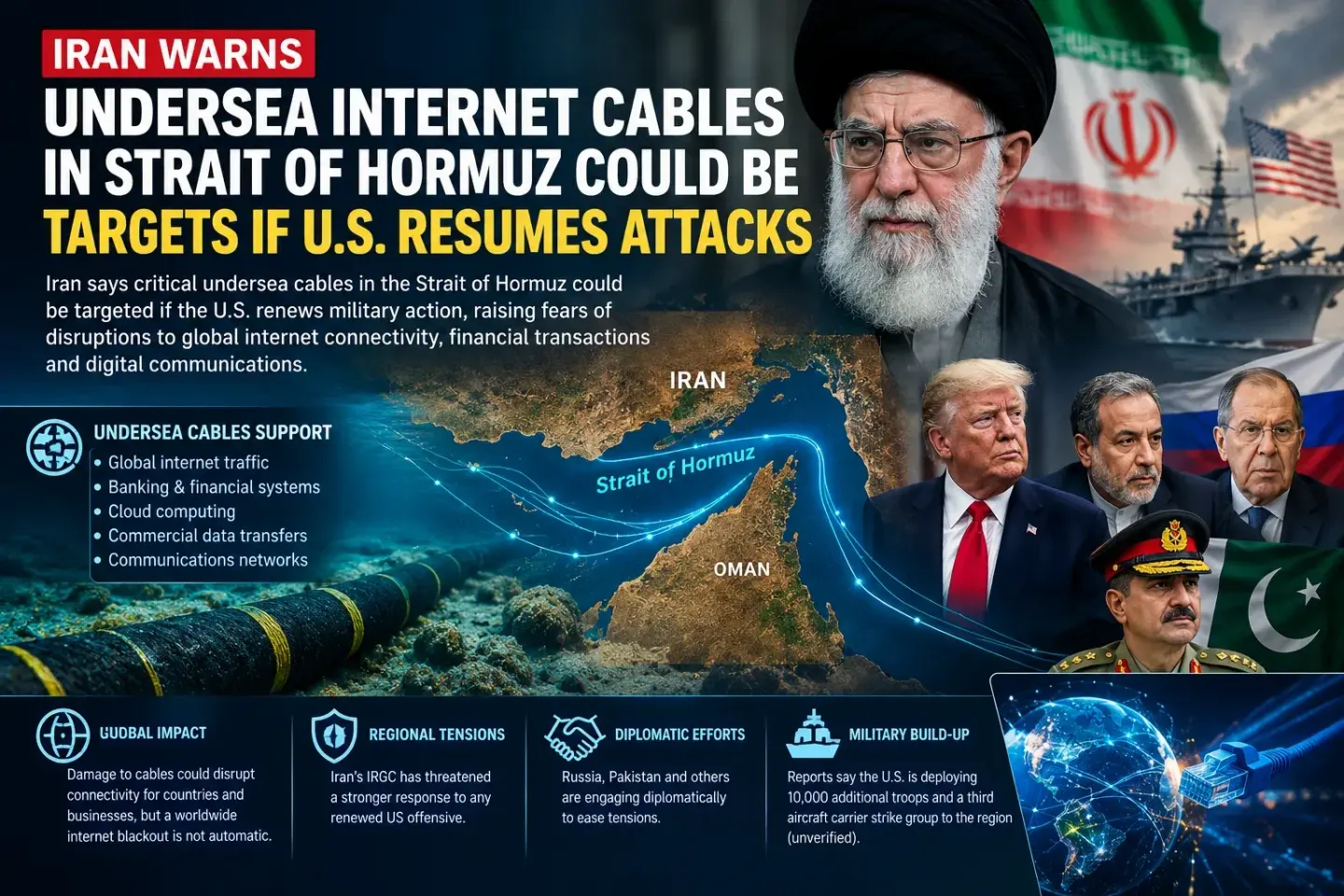
Iran has warned that critical undersea internet cables in the Strait of Hormuz could become targets if the United States resumes military attacks, raising concerns about potential disruptions to global internet connectivity, financial transactions and digital communications amid escalating tensions in West Asia.
According to the report, Iran’s Islamic Revolutionary Guard Corps (IRGC) has threatened a stronger response to any renewed US offensive. The warning highlights the strategic importance of undersea fibre-optic cables that carry international internet traffic and support banking systems, cloud computing, commercial data transfers and communications networks.
The Strait of Hormuz is a strategically important maritime corridor for global energy supplies. Damage to undersea cables in or around the region could disrupt connectivity for countries and businesses that rely on these networks. However, the extent of any potential disruption would depend on which cables were affected, the availability of alternative routes and how quickly repairs could be carried out. A worldwide internet blackout would not automatically result from damage to regional cables.
The warning comes as tensions between Washington and Tehran remain high. Iran’s foreign minister has also warned that any further US attack on an underground nuclear facility would prompt a response of comparable force. Tehran has additionally cautioned neighbouring Gulf countries against allowing their territory or military bases to be used for attacks on Iran.
US President Donald Trump, meanwhile, has claimed that American military action has significantly weakened Iran and prevented it from acquiring a nuclear weapon. Iranian officials have repeatedly denied seeking to develop nuclear weapons.
The conflict has also raised security concerns across the region. The report states that at least 17 US military, diplomatic and air-defence sites in West Asia have been damaged by Iranian drone and missile strikes since joint US-Israeli attacks against Iran began. It also reports that Washington is deploying an additional 10,000 troops and a third aircraft carrier strike group to the region. These figures and deployment details were not independently verified in the report.
Amid the military escalation, Russia has stepped up diplomatic engagement with Tehran. Russian Foreign Minister Sergey Lavrov has travelled to Iran for talks aimed at ending the conflict. Moscow has reportedly proposed placing Iran’s enriched uranium under Russian custody as a possible component of efforts to address the nuclear dispute.
Pakistan is also involved in regional diplomatic efforts. Army Chief Field Marshal Asim Munir has arrived in Tehran, according to the report, as Islamabad seeks to help ease tensions. His visit comes as relations between Pakistan and Iran face additional pressure following the suspension of trade at the Taftan and Gabd-Rimdan border crossings in Balochistan.
The combination of military threats, regional diplomatic initiatives and concerns about undersea communications infrastructure underscores the wider implications of the Iran conflict. Any damage to critical internet cables could affect international businesses, financial services and digital infrastructure, making the protection of these networks an increasingly important issue as tensions continue to escalate.




تبصرے
مفت اکاؤنٹ بنا کر بحث میں شامل ہوں۔
تبصرے لوڈ ہو رہے ہیں…