

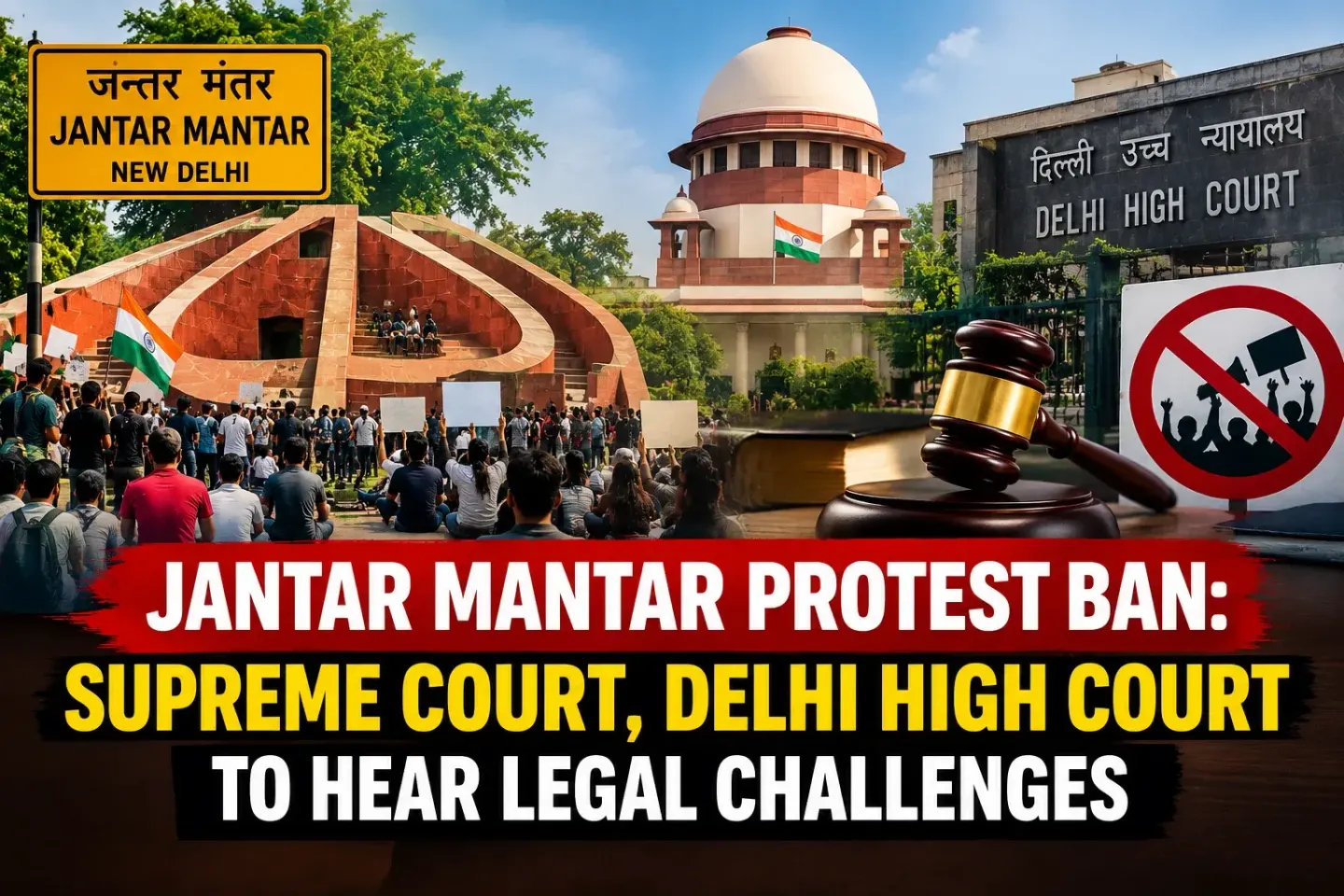
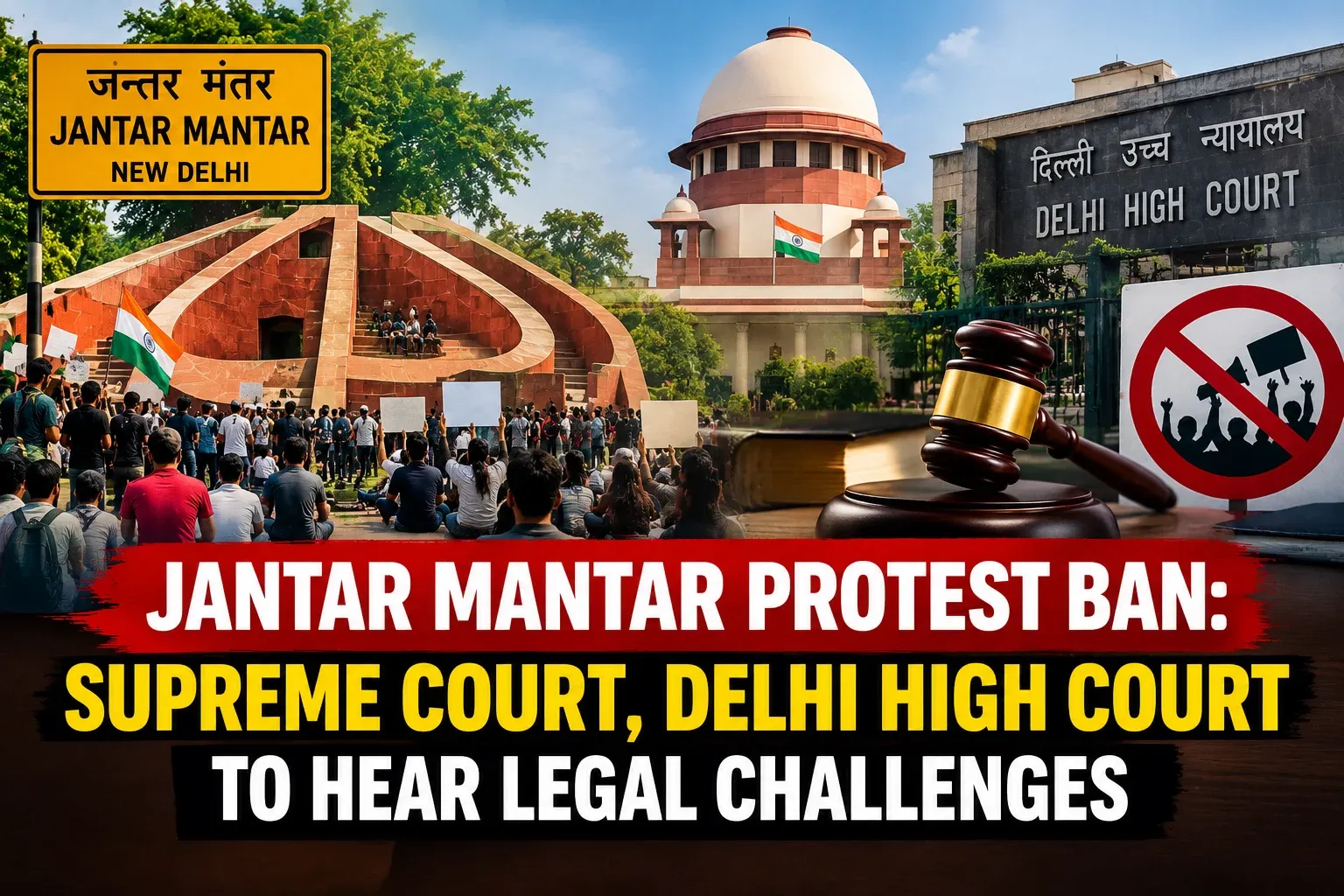
Jantar Mantar Protest Ban: Supreme Court and Delhi High Court to Hear Legal Challenges
The decision to remove Jantar Mantar from Delhi’s designated protest sites has triggered legal challenges in both the Supreme Court of India and the Delhi High Court, raising questions about the right to peaceful protest and the availability of alternative demonstration venues in the national capital.
The controversy intensified after Delhi Police denotified Jantar Mantar as an authorized protest location. Petitions challenging the decision argue that the move could affect citizens’ ability to exercise their democratic rights, including freedom of expression and peaceful assembly.
The issue has also drawn political attention following the reported detention of protesters and criticism from opposition leaders.
Supreme Court to Hear Plea Challenging Jantar Mantar Protest Ban
The Supreme Court is scheduled to hear a petition challenging the decision to remove Jantar Mantar from the list of designated protest sites, according to the supplied news report.
The petition argues that the decision threatens citizens’ right to peaceful protest and dissent. Jantar Mantar has historically served as a prominent location for demonstrations involving political, social, educational, and public policy issues.
The legal challenge places the regulation of public demonstrations at the center of a wider debate about balancing public order with democratic freedoms.
The outcome of the proceedings could clarify the legal position surrounding the use of Jantar Mantar for protests and the conditions under which authorities may restrict public gatherings.
Youth Congress Challenges Delhi Police Decision in High Court
The Indian Youth Congress has also approached the Delhi High Court to challenge the decision to denotify Jantar Mantar as a protest site.
Youth Congress president Uday Bhanu Chib has argued that Jantar Mantar represents an important symbol of democratic dissent. He has also emphasized that alternative protest venues should be accessible and affordable for citizens and political organizations.
The legal challenge reflects concerns about whether relocating demonstrations to areas farther from central Delhi could make it more difficult for protesters to organize gatherings and draw public attention to their demands.
Both court proceedings could become significant in determining how designated protest locations are regulated in the national capital.
Political Controversy After Arrests of Protesters
The dispute has intensified following the reported arrest of members associated with the Cockroach Janata Party (CJP) over alleged trespassing at Jantar Mantar.
According to the broadcast, those arrested were remanded to five days of judicial custody. Opposition leader Rahul Gandhi condemned the arrests, while CJP founder Abhijit Deepak reportedly expressed appreciation for his support.
A person speaking during the broadcast alleged that protesters, including women, had been subjected to physical mistreatment while in custody. These allegations were presented in the report but were not independently established by the supplied transcript.
The arrests and competing claims have added another dimension to the controversy, with political leaders questioning the handling of demonstrations and authorities enforcing restrictions on the use of the site.
Why Jantar Mantar Is Important for Public Protests
Jantar Mantar has become one of India's best-known locations for public demonstrations, particularly in New Delhi, where protesters have historically gathered to raise political and social concerns.
The site has hosted demonstrations over a range of issues, including government policies, educational reforms, and electoral concerns.
The latest dispute follows earlier demonstrations related to demands for educational reforms and protests concerning the Election Commission of India, as described in the broadcast.
For protesters, the location's significance is linked to its central position in the capital and its association with public political expression.
The decision to remove the site from the list of designated protest venues has therefore raised concerns about where demonstrations can take place and how easily citizens can access alternative locations.
Section 163 of BNSS and Restrictions on Public Gatherings
The report also discussed the potential consequences for people who continue to stage demonstrations at Jantar Mantar despite restrictions.
Section 163 of the Bharatiya Nagarik Suraksha Sanhita (BNSS) provides a legal mechanism for authorities to issue orders in urgent cases of nuisance or apprehended danger, including restrictions on certain gatherings where the statutory conditions are met.
The broadcast warned that violating lawful orders could lead to legal action, including detention or criminal proceedings, depending on the circumstances.
It also discussed potential penalties associated with unlawful assembly, obstructing police officers, damaging public property, and assaulting law enforcement personnel.
The specific legal consequences depend on the applicable provision, the facts of an incident, and the circumstances in which an offence is alleged to have occurred. Individuals and organizations planning demonstrations should verify the current restrictions and applicable legal requirements with the relevant authorities.
Where Can People Protest in Delhi After the Jantar Mantar Ban?
The broadcast identified three alternative locations that it said could be used for demonstrations in Delhi: Ramlila Ground, Burari Ground, and CBD Ground.
The report provided the following approximate distances and crowd capacities.
1. Ramlila Ground
Ramlila Ground was identified as an alternative protest venue approximately three kilometres from Jantar Mantar. The report stated that the location has historically hosted large public gatherings and can accommodate substantially more people than Jantar Mantar.
The broadcast cited a reported capacity of approximately 125,000 people.
2. Burari Ground
Burari Ground was presented as another possible location for large demonstrations. According to the report, it is approximately 20 kilometres from Jantar Mantar and has a reported capacity of around 50,000 people.
Its larger capacity could make it suitable for demonstrations expected to attract substantial crowds, subject to applicable permissions and restrictions.
3. CBD Ground
CBD Ground was identified as a further alternative, approximately 13 kilometres from Jantar Mantar.
The report cited a capacity of around 2,500 people, making it a smaller venue compared with Ramlila Ground and Burari Ground.
The report suggested that organizers should consider the expected size of a demonstration and coordinate with police regarding the appropriate location.
What Happens to Protesters Who Continue Gathering at Jantar Mantar?
The future of demonstrations at Jantar Mantar will depend on the applicable police orders and the outcome of the ongoing legal challenges.
The report stated that authorities could take action against gatherings held in violation of lawful restrictions. Depending on the circumstances, this could involve detention, the registration of a First Information Report (FIR), or other legal proceedings.
The legal position may change if a court issues an interim order, modifies the restrictions, or rules on the petitions challenging the denotification.
For protesters and political organizations, the immediate questions concern the availability of authorized venues, the requirements for obtaining permission, and the extent to which restrictions can be legally imposed.
Jantar Mantar Protest Ban
The Supreme Court and Delhi High Court proceedings are central to the unfolding dispute over the removal of Jantar Mantar from Delhi's designated protest sites.
The petitions raise questions about the balance between maintaining public order and preserving access to peaceful democratic demonstrations.
The legal proceedings may also influence how alternative protest venues are designated and whether organizers have reasonable access to locations capable of accommodating their gatherings.
Until the courts clarify the position, protesters and organizers will need to pay close attention to applicable orders and the legal status of designated demonstration sites.
The key issue remains whether Delhi can regulate where public demonstrations take place while ensuring that citizens retain meaningful opportunities to exercise their right to peaceful protest.

التعليقات
حساب مجاني يتيح لك المشاركة في النقاش.
جارٍ تحميل التعليقات…